
FEI HUANG
I build the infrastructure that designers and engineers
rely on.
PRODUCT DESIGNER I SYSTEMS • ENTERPRISE WORKFLOWS
From design infrastructure to AI interaction architecture
PREVIOUSLY BUILT SYSTEMS AT


Meta · Evolving one design system · 01 of 03
Component Library → Product Infrastructure
Collaborators
Art direction, UXR, Platform Engineering, Meta Company Design System, and business product teams
My focus
Led the convergence strategy between Geo Design System and Meta's Company Design System (CDS), defining the token architecture, visual direction, semantic foundations, and accessible foundations behind Meta's business products.
Established the architectural model for where Geo converges with CDS and where it diverges, then drove the adoption sequencing and governance infrastructure that enforced quality at every layer — from design handoff through automated code checks to org-level review — enabling 200+ designers to migrate without disrupting active product development.
Returned in 2025 for Phase 2 to address the technical debt identified during the initial rollout, including an expanded color system with accessibility guaranteed by construction, a variable font system, and a component uplift pass that made the system easier to scale over time.
Overview
Over four years at Meta, I helped evolve the Geodesic (Geo), the shared design system supporting large-scale business products across Ads Manager, Business Suite, and related enterprise surfaces. Geo 2.0 was a multi-year effort to modernize the system’s visual and technical foundations as Meta’s business products scaled beyond their original Facebook-era design language.


- Geo in Ads Manager before (left) / after (right) comparison -
Challenges
Geo couldn't scale consistently across increasingly complex workflows. The business products still reflected Facebook-era visual language after the Meta rebrand, creating gaps in trust, hierarchy, and product consistency. Product teams were extending the design language independently, the Geo and CDS relationship was undefined, and rational local decisions were compounding into system-wide drift. The longer the migration waited, the more expensive and disruptive it became.
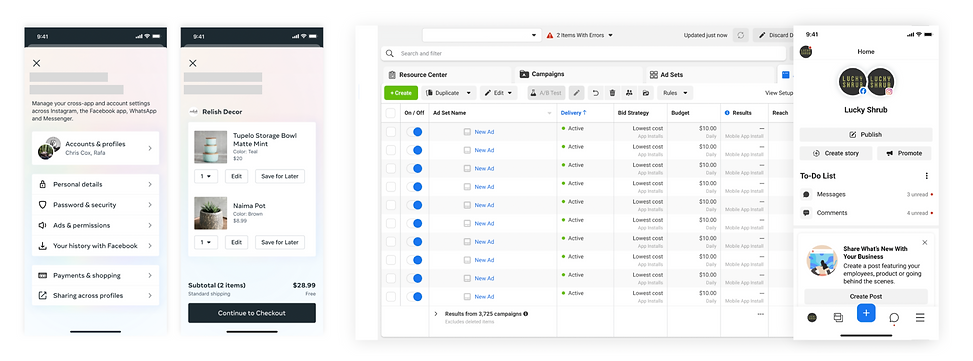
- Consumer Products in Meta rebrand CDS -
- Business Products in the Facebook era Geo -

Diagnosis & Strategy
The work began with diagnosing the underlying system constraints behind Geo’s fragmentation and slow adoption. The challenge was not only visual inconsistency, but the absence of a scalable relationship between Geo and CDS, combined with organizational pressures that made foundational changes difficult to roll out safely.
The work evaluated multiple operating models for how Geo should evolve alongside CDS, balancing shared infrastructure with the flexibility required by complex business products. This included validating brand direction through user research, defining convergence and divergence boundaries between systems, and designing rollout strategies that reduced migration risk across existing surfaces.

- CDS primitives break in business products -
System Evolution
The system evolution focused on creating more scalable visual and technical foundations across Meta's business products. This included aligning token architecture, semantic foundations, typography systems, and reusable component behaviors to support clearer hierarchy, accessibility, consistency, and post-rebrand visual alignment across dense enterprise workflows.
The core architectural decision was where Geo converges with CDS and where it diverges: where CDS served business product needs, Geo aliased the token and propagation remained automatic; where CDS primitives could not support the complexity of enterprise workflows, Geo owned the token independently. That boundary — encoded directly into the token naming convention — is what made scalable propagation and migration sustainable across product surfaces.
UXR: Brand Directions Study


SELECTED
- Existing Geo Style -
- Geo Style Aligned with CDS -
- Geo Independent Style -
Inspired by Meta brand reflected in marketing like Meta.business.com

- CDS & Geo token relationship -
Two mapping patterns. Different maintenance costs
Scaling Adoption
Enabling adoption across 200+ designers and engineers without disrupting active product development required a deliberate sequencing strategy. The rollout began with Meta Business Suite as the lower-risk validation surface, then expanded to Ads Manager. Adoption was mandatory but non-blocking: teams could not skip the migration, but the migration could not block shipping. That model, "DS owns the standard, product teams own the timeline," is what made a system-wide change possible without a system-wide pause.
The governance infrastructure established here — contribution models, CI linting gates, and migration playbooks — later became the operational foundation supporting the Data Viz system and AI behavior architecture that followed.
Impact
System impact
-
Component overrides reduced 30%, Figma library usage increased 40%, support requests reduced 25%
-
User trust improved 5–10% and usability 3–7%, validated through post-launch analysis
-
Brand identity aligned across consumer and business products after Meta's rebrand
-
Teams shifted from working around the system to building with it, "a tool that empowers rather than a constraint" based on design system satisfaction survey
Org behavior shift
-
Designers: from workarounds to system-driven building
-
PMs: from blocking adoption to self-serve adoption at scale
-
Engineers: from inconsistent output to deterministic system output